Prosecutors for the Prosecution, Then for the Defense: The DOJ Alumni Cashing In on the Cases They Once Built
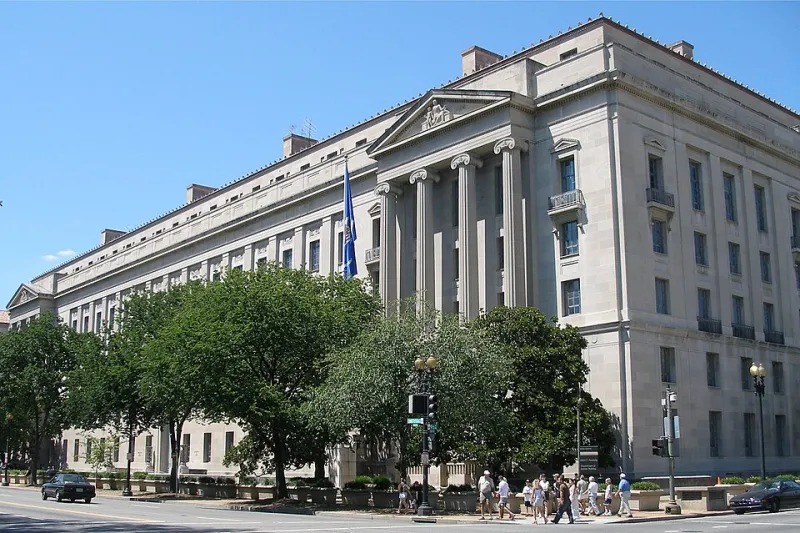
Photo: Unknown, CC BY-SA 3.0, via Wikimedia Commons
For the average American, the Department of Justice represents the full weight of federal law enforcement — the institution charged with holding corporations accountable, preserving competition in the marketplace, and ensuring that no enterprise grows so large or so brazen that it operates beyond the reach of the law. That image is not entirely false. It is, however, incomplete.
What the official portrait omits is the second act. The career prosecutors who spend years inside the DOJ's Antitrust Division, who earn institutional authority by pursuing the nation's most consequential corporate investigations, frequently depart for private law firms where their first and most lucrative clients are the very industries they once targeted. The knowledge they accumulated at taxpayer expense — the investigative playbooks, the prosecutorial thresholds, the internal deliberative processes — travels with them into the private sector, where it commands extraordinary fees.
This is not an allegation. It is a documented career trajectory, repeated across administrations of both parties, and it raises a question that Washington has shown little appetite to answer: at what point does the revolving door stop being a feature of public service and start being the point of it?
The Architecture of the Advantage
Understanding why former DOJ officials command such premium billing at white-shoe law firms requires understanding what, precisely, they are selling. It is not merely legal expertise — any competent antitrust attorney can read the Sherman Act. What former prosecutors sell is institutional intimacy: knowledge of which arguments resonate with specific career staff, awareness of which investigative thresholds trigger formal action, and familiarity with the unwritten norms that govern prosecutorial discretion.
In the Antitrust Division specifically, this knowledge is extraordinarily valuable. Major merger reviews, monopolization investigations, and criminal price-fixing cases all involve years of internal deliberation before any public action is taken. A former division chief who participated in those deliberations does not merely understand the law — he understands the culture, the risk tolerance, and the personnel of the office that may one day review his new client's conduct.
Ethics rules nominally address this dynamic. Federal law prohibits former officials from representing private parties before their former agency on matters in which they were personally and substantially involved. A one-year cooling-off period applies to senior officials. Beyond those parameters, however, the path to private practice is largely unobstructed, and the parameters themselves are riddled with workarounds that any competent Washington attorney can navigate.
The Case Files That Follow Them Out the Door
The most striking illustrations of this pattern involve officials who depart mid-investigation — or shortly after a case's resolution — and promptly appear on the opposing side of analogous disputes.
Consider the trajectory of senior Antitrust Division officials who oversaw the government's scrutiny of major technology platforms during the late 2010s and early 2020s. Several of those officials, upon departing the division, joined law firms that had retained those same platforms as clients, or moved directly to in-house counsel roles at companies whose competitive practices had drawn federal scrutiny. In each instance, the applicable ethics rules were technically satisfied. In each instance, the substantive conflict was apparent to any disinterested observer.
Similar patterns emerged from the DOJ's aggressive pursuit of pharmaceutical mergers and healthcare consolidation. Career officials who spent years developing the government's analytical framework for evaluating competitive harm in drug markets subsequently applied that framework — in reverse — on behalf of the very hospital systems and pharmaceutical manufacturers whose acquisitions they had once scrutinized. The legal fees generated by a single major merger defense can reach into the tens of millions of dollars. A former division chief who can credibly promise insight into the government's decision-making calculus is not a marginal asset in that context. He is the entire value proposition.
Regulatory Capture by Another Name
The conventional framing of regulatory capture focuses on industry influence over sitting regulators — the lobbyist who cultivates relationships with agency staff, the trade association that shapes the rulemaking record. The revolving door operates through a subtler mechanism, but its effects are comparably corrosive.
When ambitious prosecutors understand that their career arc will likely carry them into the private defense bar, their incentives inside the government are quietly distorted. This does not require conscious corruption. It requires only the ordinary human tendency to avoid burning bridges with the professional community in which one expects to spend the bulk of one's career. The prosecutor who is too aggressive, who makes too many enemies among the defense bar, who develops a reputation for scorched-earth litigation tactics, may find the private sector less welcoming upon departure.
The result is a prosecutorial culture that is, at the margin, more deferential to corporate defendants than the public interest strictly requires. Settlements are negotiated where prosecutions might be warranted. Consent decrees are accepted where structural remedies might be demanded. The individual decisions are defensible on their merits; the aggregate pattern is not.
The Reform Proposals Nobody Is Seriously Considering
A small number of legislators and legal scholars have proposed substantive reforms. Extended cooling-off periods — five years rather than one — have been suggested for senior Antitrust Division officials. Lifetime bans on representing clients in matters directly related to one's government work have been proposed and ignored. Some advocates have called for mandatory public disclosure of post-government employment for any official who participated in significant enforcement decisions.
None of these proposals has achieved legislative traction, and the reasons are not difficult to identify. The legal and lobbying industries that would be most constrained by such reforms are among the most influential participants in the legislative process. The bipartisan consensus in Washington on this question — to the extent one exists — is that the current arrangement suits the relevant stakeholders adequately.
More fundamentally, the revolving door at the DOJ is not an aberration within an otherwise functional system. It is the system expressing its priorities with unusual clarity. An institution that consistently trains its best prosecutors to become the private sector's most effective defenders is not suffering from a policy failure. It is delivering precisely the outcome its structural incentives predict.
What the Public Is Actually Owed
The American taxpayer funds the Department of Justice's Antitrust Division to the tune of hundreds of millions of dollars annually. That investment pays for the investigators, the economists, the litigators, and the years of institutional knowledge required to mount credible challenges to the market power of the nation's largest corporations. When that knowledge walks out the door and immediately begins serving the interests of those same corporations, the public has not merely been denied a return on its investment. It has subsidized the construction of the very defenses it will later face.
The revolving door at Main Justice is not a secret. It is documented in law firm press releases, in bar association profiles, and in the public financial disclosures that senior officials are required to file. The information is available to anyone willing to look. What has been absent, until now, is the willingness to state plainly what that information reveals: that the Department of Justice, in its current configuration, functions in significant part as a finishing school for the corporate defense bar — and that the corporations it nominally regulates have long since figured that out.