Securing the Border, Securing the Contract: How Homeland Security Became a Revolving Door for Defense Industry Insiders
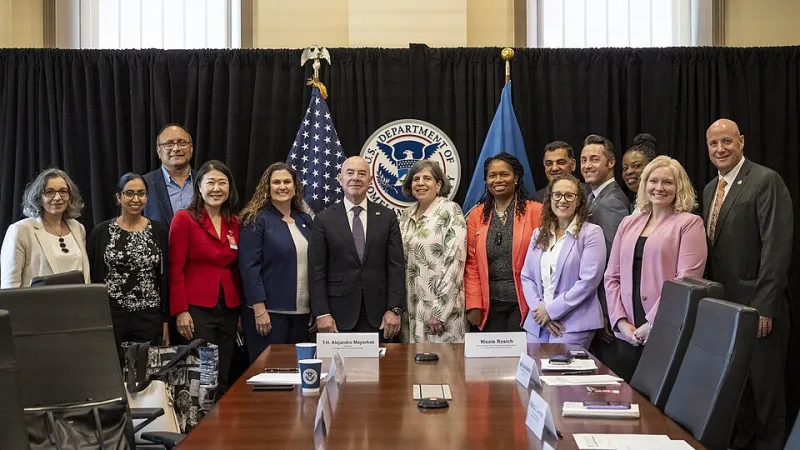
Photo: DHSgov, Public domain, via Wikimedia Commons
A pattern has emerged at the Department of Homeland Security that should concern every American who believes in accountable government: the officials who write immigration enforcement policy are often the same people who, months or years earlier, drew salaries from the contractors now executing those policies. This is not coincidence. It is a system, and it has been decades in the making.
The Architecture of Influence
Since DHS was established in the wake of September 11, 2001, the department has grown into one of the largest procurement agencies in the federal government. Its annual contracting budget now exceeds $20 billion, a figure that has attracted sustained interest from defense and security firms eager to capture a share of what amounts to a permanent, federally guaranteed revenue stream. Companies such as Palantir Technologies, General Dynamics Information Technology, Accenture Federal Services, and a constellation of smaller surveillance and detention specialists have collectively received tens of billions of dollars in DHS contracts over the past two decades.
What makes this arrangement particularly worth scrutinizing is not the contracting itself — government agencies must procure goods and services — but rather the human infrastructure that connects agency leadership to industry boardrooms. Senior DHS officials, including undersecretaries, assistant secretaries, and senior advisors, routinely depart the department and accept positions at the very firms whose federal contracts they recently helped to oversee or expand. The reverse pathway is equally well-traveled: industry veterans arrive at DHS carrying deep knowledge of contractor capabilities, corporate priorities, and the precise policy levers that can unlock additional government spending.
Personnel as Policy
Consider the trajectory of senior officials who have cycled between border enforcement leadership and the private security sector. Former Customs and Border Protection commissioners and ICE directors have, upon leaving government, accepted advisory roles, board seats, and consulting arrangements with firms that manufacture surveillance technology, operate detention facilities, and provide deportation logistics. Their successors within the agencies they vacated are frequently drawn from the same pool of industry professionals, ensuring that institutional memory and policy preference remain aligned with contractor interests regardless of which political party occupies the White House.
This dynamic produces a specific and measurable effect on policy. Enforcement strategies that rely heavily on technology — biometric tracking, predictive analytics, remote surveillance systems, and expanded detention capacity — receive sustained bureaucratic support, not simply because they are effective, but because they are profitable for the companies that supply them. Alternatives that emphasize legal processing efficiency, diplomatic engagement, or community-based monitoring receive comparatively little institutional enthusiasm, in part because they generate fewer procurement opportunities.
The result is an enforcement apparatus that is perpetually oriented toward expansion. Each new contract establishes a baseline; each contract renewal becomes an argument for increased capability; each capability increase generates justification for further contracting. The officials who design this architecture understand, from personal experience, precisely where the next opportunity for growth will emerge.
The Detention Economy
Perhaps no sector illustrates this dynamic more starkly than immigrant detention. The United States currently maintains one of the largest immigration detention systems in the world, with daily population figures that have fluctuated between 20,000 and 50,000 individuals depending on the administration and its enforcement priorities. The facilities housing these individuals are operated, in significant part, by private contractors whose revenues are directly tied to occupancy rates.
Former DHS officials who now serve as lobbyists or executives for detention operators have been instrumental in preserving and expanding congressionally mandated detention bed minimums — statutory requirements that effectively guarantee a minimum level of business for their employers. These minimums have survived multiple administrations and have resisted reform efforts in part because the lobbying apparatus defending them is staffed by individuals who understand the department's internal deliberations with unusual precision.
The financial logic is straightforward. A former senior official who helped draft detention standards, negotiated facility contracts, or oversaw compliance inspections possesses knowledge that commands a substantial premium in the private market. That premium is not paid for general management skill. It is paid for access, relationships, and the ability to anticipate and shape the regulatory environment from outside the government.
Technology and the Surveillance Dividend
Beyond detention, the surveillance and data analytics sector has emerged as another primary beneficiary of the DHS revolving door. Contracts for biometric identification systems, license plate readers, border sensor networks, and algorithmic threat assessment tools have expanded dramatically, driven in part by officials who arrived at the department with prior industry experience and departed with enhanced credibility to market their services back to it.
The ethical complications here extend beyond simple conflict of interest. When the officials responsible for evaluating the efficacy and civil liberties implications of surveillance technology have financial relationships — past or prospective — with the companies supplying that technology, the integrity of those evaluations is structurally compromised. The public has no reliable mechanism for distinguishing between a policy judgment made on the merits and one made in anticipation of future employment.
What Accountability Would Require
Addressing this problem is neither simple nor politically comfortable, because the revolving door serves interests on both sides of the partisan aisle. Democratic administrations have been no less susceptible to industry capture at DHS than Republican ones; the contractors themselves donate carefully and lobby both parties with equal sophistication.
Meaningful reform would require, at minimum, substantially extended cooling-off periods for senior officials before they may accept employment with contractors they oversaw, mandatory public disclosure of all post-government employment for senior DHS personnel, and genuine enforcement of existing ethics rules that are currently honored more in their breach than their observance.
Absent such reforms, the American public will continue to fund an immigration enforcement system whose strategic direction is shaped, in no small part, by the profit calculations of the companies contracted to execute it. The border may or may not be secure. The contracts, however, very much are.