Architects of the Prosecution: How DOJ Veterans Built the Playbook They Now Use Against the Government
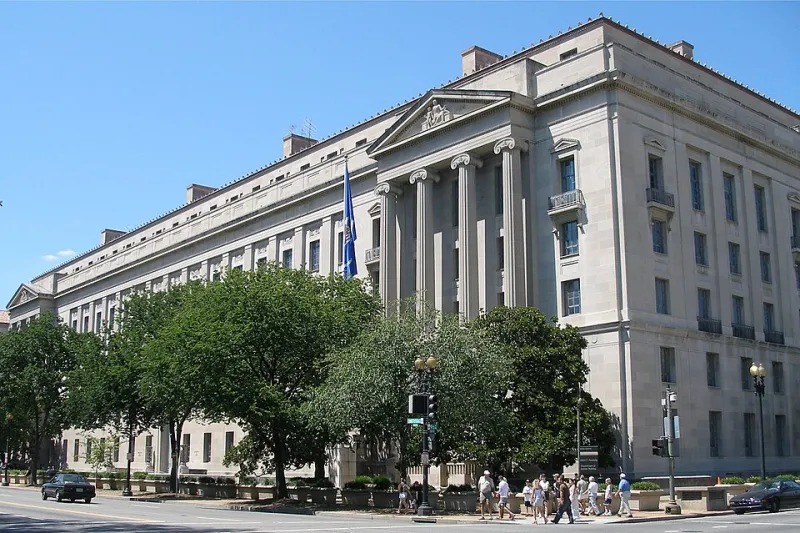
Photo: US Department of Justice, Public domain, via Wikimedia Commons
There is a particular irony embedded in the American justice system that receives far less scrutiny than it deserves. The men and women who spend years inside the Department of Justice crafting the prosecutorial strategies, negotiating the plea frameworks, and designing the regulatory guidance that govern white-collar enforcement do not, as a rule, retire quietly. They move — often within months of leaving their government posts — into the corner offices of elite law firms, where their most valuable asset is not their legal acumen in the abstract, but their intimate familiarity with the machinery they once operated.
This is the revolving door at its most consequential, and it has been turning for decades with barely a creak of public protest.
The Knowledge Transfer Nobody Talks About
When a senior DOJ official departs federal service, they carry with them something no amount of private-sector training can replicate: an insider's understanding of how prosecutors think, what evidence they prioritize, which charging decisions reflect institutional pressure rather than legal merit, and — critically — where the weaknesses in the government's own frameworks lie.
For a corporation facing a criminal investigation, or a financier staring down a securities fraud indictment, that knowledge is not merely useful. It is worth retaining at rates that can exceed a thousand dollars per hour.
The dynamic creates a structural incentive that deserves far more public examination than it receives. A prosecutor who knows that a lucrative private-sector career awaits upon departure has a powerful, if rarely acknowledged, reason to cultivate relationships with the defense bar, to avoid burning bridges with the firms that will one day pay their salary, and — in some cases — to craft prosecutorial policies that, while appearing rigorous on their face, contain the very ambiguities and procedural off-ramps that skilled defense attorneys can later exploit.
Case Studies in Institutional Memory
Consider the trajectory of officials who served in the DOJ's Criminal Division during periods of significant white-collar enforcement activity. Several veterans of the Fraud Section, the unit responsible for prosecuting complex financial crimes, have transitioned into private practice at firms that specialize in representing precisely the categories of defendants — investment banks, pharmaceutical companies, healthcare conglomerates — that the Fraud Section targets.
In at least several well-documented instances, former section chiefs and deputy assistant attorneys general have appeared as lead defense counsel in cases prosecuted under legal theories they personally helped develop during their government tenure. The deferred prosecution agreement framework, for example — a mechanism that allows corporations to avoid criminal conviction by paying fines and agreeing to monitoring — was substantially shaped by DOJ insiders who, upon leaving government, built practices centered on negotiating those very agreements on behalf of corporate clients.
The result is a closed loop of institutional expertise. The government develops an enforcement tool. The official who developed it departs. That official then advises clients on how to navigate, minimize, or neutralize the tool's impact. The government, staffed by a new generation of officials who will eventually follow the same career path, rarely challenges the arrangement.
The Ethics Rules That Don't Reach Far Enough
Federal ethics regulations do impose some constraints on former government attorneys. The most significant is a lifetime ban on personally representing private clients in matters in which the attorney was personally and substantially involved while at the DOJ. A narrower, time-limited restriction applies to matters that were pending under the attorney's official responsibility.
On paper, these rules sound robust. In practice, their limitations are significant. The "personally and substantially involved" standard is interpreted narrowly. An official who set broad enforcement policy — who decided, for instance, that a particular category of financial conduct warranted heightened prosecutorial attention, or who drafted the guidance memoranda that governed an entire division's charging decisions — may not have been "personally and substantially involved" in any specific case, even if their policy decisions created the legal landscape in which those cases were built.
This is precisely where the revolving door's machinery operates most smoothly. The most valuable former officials are often not those who tried specific cases, but those who shaped the institutional culture, the charging philosophy, and the internal risk calculus that governs how the DOJ approaches entire categories of crime. That knowledge is not covered by any ethics rule currently on the books.
A System That Serves Itself
The uncomfortable reality is that this arrangement suits virtually every party involved — except the American public.
The law firms profit handsomely from the reputational and informational premium attached to former government officials. The former officials themselves secure compensation packages that dwarf their government salaries. Corporate defendants gain access to counsel whose greatest selling point is knowing, from the inside, how the government will move against them. And the DOJ, for its part, benefits from a recruitment pipeline in which ambitious young attorneys are willing to accept below-market government salaries precisely because they understand that a lucrative private-sector career awaits those who perform well.
What this system does not serve is equal justice under law. The corporation with the resources to retain a former Criminal Division chief begins its legal contest with an asymmetric advantage that no amount of prosecutorial zeal can entirely overcome. The legal strategies that official helped construct while drawing a government paycheck are now deployed, with surgical precision, against the institution that trained him.
The Reform Conversation Washington Won't Have
A serious conversation about structural reform would consider extending the "cooling off" period before former DOJ officials may represent clients in matters touching their former areas of policy responsibility. It would examine whether the current ethics framework adequately addresses officials whose influence was exercised through policy rather than case-level involvement. It would ask whether the public interest is served by a justice system whose most knowledgeable veterans are systematically incentivized to deploy that knowledge against it.
These are not radical proposals. They are the kinds of structural safeguards that any honest assessment of the current arrangement would suggest. Yet the legal establishment — which benefits enormously from the status quo — has shown little appetite for examining the system it inhabits.
The revolving door between the DOJ and the white-collar defense bar is not a scandal in the traditional sense. No single official has necessarily violated any rule. No specific transaction can be pointed to as the moment the public trust was breached. The problem is structural, which makes it simultaneously more pervasive and more resistant to accountability.
The architects of the prosecution have become the architects of the defense. They built the playbook, and now they sell it back to the highest bidder. That is not a justice system functioning as designed. It is a justice system functioning precisely as its most influential participants have arranged it to function — and the difference matters enormously to anyone who still believes the law should apply equally to all.